

Categories
Financing & Mortgage Advice, Home Buying Tips, Home Improvement & ROI, Home Selling Strategies, Investment & Income Properties, Luxury & Dream Homes, Market Insights & Trends, Neighborhood Spotlights, Real Estate Process & EducationPublished April 10, 2026
Can We Predict Housing Demand Decades in Advance? The Answer Is in the Birth Data

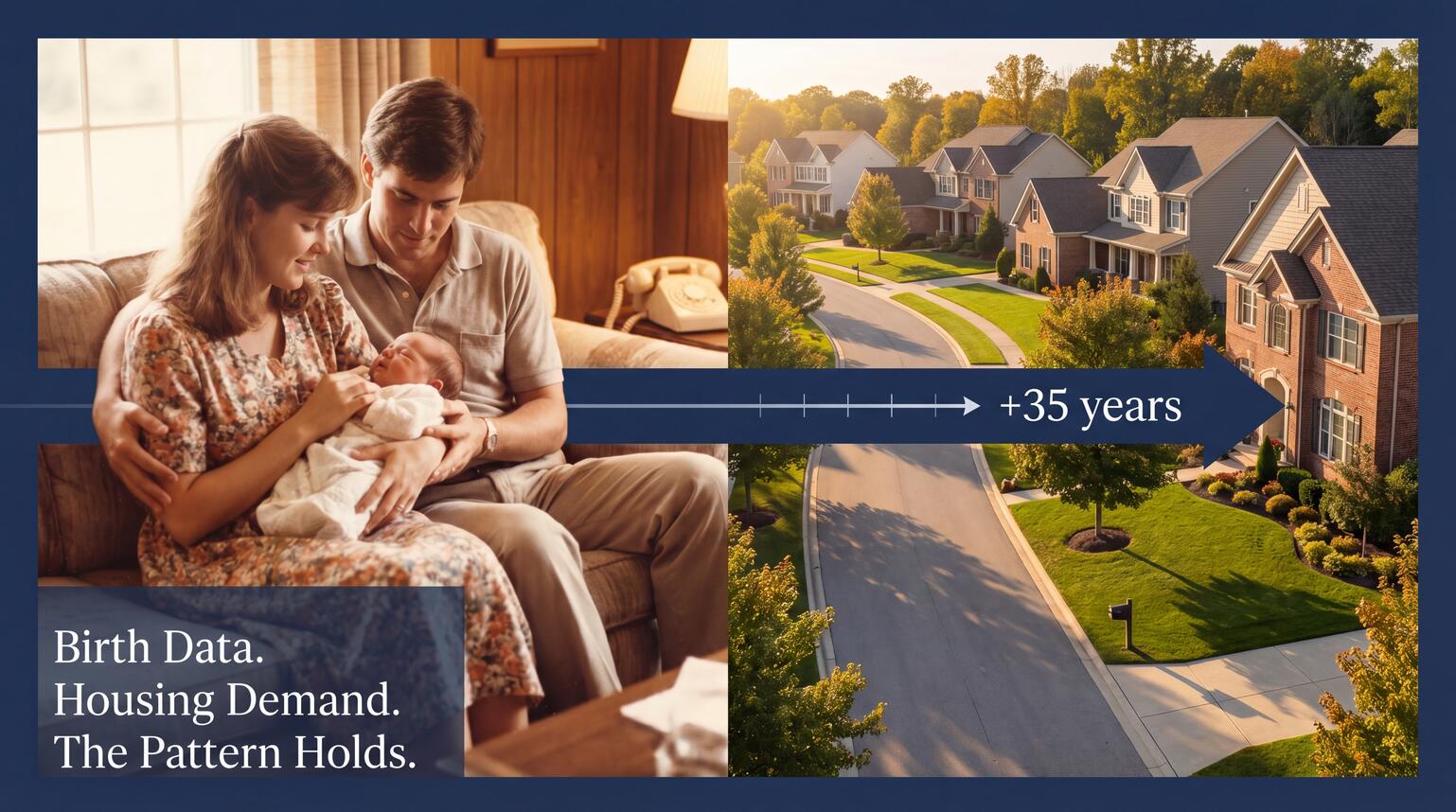
What U.S. Birth Records From 35 Years Ago Tell Us About McHenry County Real Estate Right Now — and Through the 2030s
By Shawn Strach, Designated Managing Broker — Dream Real Estate April 2026
A few years ago, I came across a concept from Barry Habib and his team at MBS Highway that genuinely stopped me in my tracks.
Habib spends his days tracking mortgage-backed securities — interest rates, bond markets, the mechanics behind every mortgage being written in America. But one of the most powerful forecasting tools in his research isn't a financial model. It's a birth chart.
The idea is straightforward: count the babies born in a given year, add roughly 35 years, and you can predict how many new homes will need to be built. Those babies become first-time buyers and move-up buyers who drive housing demand. It sounds almost too simple to be useful. But when you overlay the actual data — U.S. birth records from the CDC against Census Bureau housing start figures — the correlation is striking. The pattern holds across decades.
After 23 years in McHenry County real estate — working through hot markets, slow markets, the crash of 2008, and everything since — I've seen more market analysis than I can count. But this one genuinely reframed how I think about the long game.
Here's what the data shows, and what it means for buyers and sellers in our market.
The Pattern That Keeps Showing Up
The Baby Boom ran roughly from 1946 through 1964. During those years, the U.S. averaged between 3.8 and 4.3 million births annually. At its peak in 1957, there were 4.31 million babies born in a single year — the highest number in the 20th century.
Add 35 years. That cohort hits home-buying age in the late 1980s through the early 2000s. And right on cue, housing starts climbed steadily from around 1 million annually in the early 1980s to over 2 million by 2005. The demographic wave arrived almost exactly on schedule, consistent with CDC birth data from three-and-a-half decades earlier.
Three key data points anchor this:
- Peak annual births, Baby Boom (1957): 4.31 million
- Years from birth to first home purchase: ~35
- Correlation coefficient, births vs. housing starts: ~0.83
Then the Boom ended. Birth rates fell sharply in the late 1960s and bottomed out in the early 1970s — just 3.14 million births per year. Add 35 years: that lands squarely on 2007 to 2012.
Those years don't just align with the financial crisis. They align with the smallest first-time buyer cohort the country had seen in decades. The demographic floor and the economic floor collapsed at the same moment.
That's not a coincidence.
The Exception That Actually Proves the Rule
If you're familiar with the mid-2000s housing bubble, you might be thinking: "But housing starts in 2004–2006 were wildly higher than the birth data would predict. Doesn't that break the pattern?"
It actually reinforces it.
The construction surge of that era was driven by loose lending, exotic mortgage products, and speculative development that had nothing to do with real demographic demand. When that artificial demand disappeared, housing starts didn't just fall back to a normal level — they crashed well below it, overcorrecting before eventually settling back toward what the underlying birth cohort actually supported.
The demographic floor held. It always has. You can temporarily borrow from future demand or suppress it with economic conditions, but you can't manufacture buyers who don't exist — and you can't make buyers disappear who genuinely do.
How the Pattern Played Out: A Timeline
1957 — The Baby Boom peaks 4.31 million births — the highest single year of the 20th century. These children will reshape housing markets for decades.
1992–2000 — Boomers hit prime buying age Housing starts climb from 1.0M to 1.6M annually as the largest generation in history enters the market as buyers and move-up purchasers.
1973 — The post-Boom trough Annual births drop to 3.14 million — a birth deficit that will translate into a housing demand deficit exactly 35 years later.
2008–2012 — The smallest cohort arrives Housing starts crater to 550,000 — a 60-year low. The financial crisis gets the headlines. The demographics were already pointing here.
1985–1992 — The next wave is born 3.7 to 4.2 million births annually. These are the buyers of the 2020s and 2030s. Many of them are already in McHenry County.
What This Means for McHenry County Right Now
The 1985–1992 birth cohort is now 33 to 41 years old. That places millions of Americans squarely in what has historically been the most active first-time and move-up buying window of their lives.
The demand is real. What's suppressing it right now isn't a shortage of buyers — it's the rate environment keeping would-be buyers on the sideline.
Pent-up demand doesn't disappear. It accumulates.
When rates shift — and historically, they always do — this cohort doesn't ease into the market. It surges. We've watched that pattern before: the moment affordability opens even slightly, the demographic wave that's been waiting moves fast and in volume.
As of February 2026, we're already seeing the early signs of this in McHenry County. The median sales price is $354,000 — up 4.1% year-over-year — and the median home is going under contract in just 15 days. Inventory sits at just 1.6 months of supply. The demand is there. It's just being metered by monthly payment math right now.
📊 For a full breakdown of where the market stands today, read our [McHenry County Real Estate Market Report: Q1 2026]
The Demographic Shift That Extends This Wave Even Further
There's a structural change worth knowing about that extends the timeline of this analysis.
The average age of a first-time homebuyer has shifted significantly over the past two decades — from roughly 32 years old to closer to 40. Households are forming later. Children are arriving later. The homeownership decision is following the same trajectory.
This means the demographic support for housing demand from the 1985–1992 birth cohort extends further into the 2030s than it would have for the same cohort a generation ago. The wave is bigger and slower-moving than historical averages would suggest.
For anyone making long-term decisions about real estate in McHenry County — whether that's buying, selling, holding, or investing — this is relevant information.
Why McHenry County Is Well-Positioned for This Wave
Every market is going to feel this demographic pressure, but not every market is equally positioned to capture it.
McHenry County sits in an advantageous spot for several reasons:
Relative affordability. At a median sales price of $354,000, McHenry County offers considerably more home per dollar than DuPage, Lake, or Cook counties. For a first-time buyer or a move-up buyer stretching their budget, this county delivers.
Quality school districts. Families in the 35–42 age range — the core of the current buyer wave — are making school district decisions alongside home purchase decisions. McHenry County's public schools are a consistent draw.
Lifestyle attributes. Lakes, parks, recreational amenities, and a lower-density lifestyle are increasingly valued by buyers leaving denser suburbs. That's an audience McHenry County speaks to naturally.
Commuter accessibility. Whether it's Metra access or highway routes into the Chicago metro, McHenry County's commuter positioning has improved alongside remote and hybrid work flexibility — making it viable for buyers who might never have considered it before.
The combination of those factors means that as the demographic wave builds, McHenry County is likely to see sustained, genuine demand — not speculative froth.
What This Means If You're Thinking About Selling
Understanding the long-term demographic backdrop doesn't mean you wait for the wave to arrive. It means you can act from a position of clarity.
If you're thinking about selling in the next one to three years, the demographic data supports an optimistic outlook — the buyer pool for McHenry County is structurally large and growing. But the market rewards sellers who execute correctly right now, not sellers who assume the market will carry mediocre preparation and overpriced listings.
📖 For a detailed breakdown of what matters most when selling in today's McHenry County market: [What Sellers Want From a Real Estate Agent in McHenry County]
What This Means If You're Thinking About Buying
If you're in the 30–42 age range and you've been waiting for the "right" market — you're describing the exact buyer this demographic wave is made of. And you're not alone in waiting.
When rates shift, the buyers currently waiting don't spread out over years. They move together. The window to act before that competition intensifies is now — particularly in a county with 1.6 months of inventory.
The question isn't whether the demand is coming. It's whether you want to be ahead of it or competing within it.
🏡 Curious what you could buy in McHenry County right now? [Find out what your current home is worth first]
Why I Track This Kind of Analysis
I share this because I believe the people in my database deserve more than a monthly report full of median price statistics.
Median prices tell you where the market has been. Demographic data gives you a framework for where it's going.
Real estate decisions — whether you're buying your first home, moving up, downsizing, or figuring out whether to sell now or wait — benefit enormously from understanding the larger forces at play. Interest rates move in months. Demographics move in decades. Knowing both gives you a genuine edge.
At Dream Real Estate, that's what we try to bring to every conversation. Not just transaction management — actual intelligence about the market you're operating in. It's part of why 95% of our business comes from referrals and repeat clients across 1,700+ combined transactions over 21+ years in McHenry County.
Our team includes Sue Miller — former Illinois REALTORS President (2021), NAR Director for over two decades, and 2017 Illinois REALTOR® of the Year with 982+ transactions over 41 years — alongside a team that has worked every corner of this county across every kind of market.
If you've found this useful, the most valuable thing I can do is keep sending you this kind of analysis.
Frequently Asked Questions
What does birth rate data have to do with housing demand?
Birth rates from approximately 35 years ago reliably predict housing demand because the people born in a given year tend to become first-time homebuyers roughly 35 years later. When large birth cohorts — like the Baby Boom of 1946–1964 — reach that age, housing demand surges. When smaller cohorts — like those born in the early 1970s — reach it, demand weakens. This relationship has held across multiple decades of CDC birth data and U.S. Census housing start figures.
Is McHenry County real estate expected to grow in demand?
Yes, based on demographic data. The 1985–1992 U.S. birth cohort — now 33–41 years old — represents millions of Americans entering their prime first-time and move-up homebuying years. McHenry County's relative affordability, quality school districts, lake lifestyle amenities, and commuter positioning make it a natural destination for this buyer wave. Current inventory in McHenry County sits at just 1.6 months of supply as of Q1 2026, which already reflects strong underlying demand.
What is the current McHenry County real estate market like in 2026?
As of February 2026, the median sales price for single-family homes in McHenry County is $354,000 — up 4.1% year-over-year — with a median of 15 days on market. Active listings stand at 571 homes with 1.6 months of supply. The market is strategic rather than frenetic: well-priced homes move in two weeks, while overpriced homes sit and negotiate. Source: MRED/InfoSparks.
Who is Barry Habib and why does his birth data analysis matter?
Barry Habib is the founder of MBS Highway, a platform used by mortgage and real estate professionals to analyze interest rate trends and housing market conditions. His research connecting U.S. birth cohort data to housing starts helped popularize the 35-year demographic lag concept in real estate forecasting. When birth data is overlaid against housing construction data with a 35-year offset, the correlation is approximately 0.83 — meaning the relationship is statistically significant, not coincidental.
When is the best time to buy a home in McHenry County given the demographic outlook?
The demographic data supports buying before the pent-up buyer wave fully arrives, rather than competing within it. With a large birth cohort now at prime buying age and rates still suppressing some demand, buyers today face less competition than they will when affordability improves and that wave mobilizes. McHenry County's 1.6 months of inventory already reflects constrained supply. Acting now means buying ahead of likely increased competition — and potentially increased prices — over the next several years.
How do I find out what my McHenry County home is worth in this market?
The most accurate way is a Comparative Market Analysis (CMA) from a local agent with direct MRED access and real transaction history in your specific municipality. National automated tools miss the hyperlocal demand nuances that move values significantly across McHenry County. Dream Real Estate provides free, no-obligation CMAs built on current MRED sold data, with a net proceeds projection included. Call or text Shawn Strach at (815) 472-7720 or request one at dreamrealestate.org/home_value.
More From Dream Real Estate
- 📊 [McHenry County Real Estate Market Report: Q1 2026]
- 🏡 [What Sellers Want From a Real Estate Agent in McHenry County]
- 💰 [What Is My Home Worth in McHenry County? (2026 Guide)]
- ⚖️ [FSBO vs. Hiring a Real Estate Agent in McHenry County]
Stay Ahead of the Market
If you found this useful, this is the kind of analysis I send a few times a year to the people in my database. Not listings blasts. Not generic market updates. Substantive intelligence on where the McHenry County market is heading and why.
📞 Ready to talk through what this means for your specific situation?
Call or text Shawn directly: (815) 472-7720
🌐 Get your free home valuation: [shawn.dreamrealestate.org/home_value]
Dream Real Estate | McHenry County Shawn Strach, Designated Managing Broker | 750+ personal transactions | 23 years Data Sources: CDC/NCHS National Vital Statistics System | U.S. Census Bureau & HUD New Residential Construction Survey | MBS Highway | MRED/InfoSparks — McHenry County Single-Family, February 2026
|


or another way